|
|
Allan Quatermain (c.1815-c.1886), Adventurer
The Dates
The dates I estimate for Allan
(c.1815-c.1886)
are based on information in the books about him.
Born
The first book about
him according to internal chronology, Marie,
says that ``as a very young man'' he accompanied Piet Retief's
Boer expedition to the
 Zulu king Dingaan (Shaka Zulu's half brother).
There was one such expedition in
1830.
However, in the novel Allan and the editor both mention the
year 1835 in relation to when he first met Retief,
so apparently the expedition in question was in 1835.
I'm assuming very young man means younger than 21;
let's say he was 20 years old, and then he was born about 1815.
Or maybe he was precocious and was 15 in 1835, so born about 1820.
Zulu king Dingaan (Shaka Zulu's half brother).
There was one such expedition in
1830.
However, in the novel Allan and the editor both mention the
year 1835 in relation to when he first met Retief,
so apparently the expedition in question was in 1835.
I'm assuming very young man means younger than 21;
let's say he was 20 years old, and then he was born about 1815.
Or maybe he was precocious and was 15 in 1835, so born about 1820.
 Encounter south africa says
Retief visited Dingaan in October 1837,
so maybe Allan Quatermain was born about 1817.
Dingaan had his men kill Retief 6 February 1838,
so the AQ couldn't have met Retief any later than that.
Encounter south africa says
Retief visited Dingaan in October 1837,
so maybe Allan Quatermain was born about 1817.
Dingaan had his men kill Retief 6 February 1838,
so the AQ couldn't have met Retief any later than that.
At the beginning of King Solomon's Mines Allan says
that he is 55 years old.
At the end of that book, he quotes a letter dated
1 October 1884;
thus he must have been born about 1829.
If so, he must have been very precocious in 1835 to have been
fighting wars and getting married at the age of 6.
Since Marie was written much later, let's assume
the early dates in that novel are more correct,
and lets retain the estimate of 1815 for his birth year.
 The Marie of the novel by that title was Marie Marais,
Allan's first wife; they both lived in Boer South Africa;
her father was a French Huguenot.
The Marie of the novel by that title was Marie Marais,
Allan's first wife; they both lived in Boer South Africa;
her father was a French Huguenot.
Died
The story of Marie was supposedly found in a manuscript
found by the keeper of his estate, who in a fictional letter
dated January 17th, 1909, says,
``The Court,
however, not being satisfied that there was any legal proof of his
death, invested the capital funds in trustee securities, and by my
advice let his place in Yorkshire to a tenant who has remained in
occupation of it during the last two decades.''
—Mr. George
Curtis, in Marie
Two decades before would have been about 1889.
There is an editorial note in the second book written about Allan,
which was the one in which he died:
``*{By a sad coincidence, since the above was written by Mr
Quatermain, the Masai have, in April 1886, massacred a missionary
and his wife--Mr and Mrs Houghton--on this very Tana River, and
at the spot described. These are, I believe, the first white
people who are known to have fallen victims to this cruel tribe.
--EDITOR.}''
—
Allan Quatermain
So internal evidence indicates that the book was written about
1885, purportedly by Allan himself.
That also estimates the year of his death, since he last wrote
in it just before he died.
Let's also take into account
Allan's comments in Allan Quatermain that it had been
two years since he had buried his son, and that he had been ``several years''
in England, after forty years in the wild.
Two years after he was moving to England at the end of
King Solomon's Mines in 1884 would be 1886.
So Allan Quatermain must be set in 1886 or later.
Let's say 1886, which is the year before the latter book was published,
and thus probably the year Haggard finished working on it.
It
is said
that Haggard wrote that book in ten weeks in 1885,
but the editorial remark indicates someone edited it in 1886.
Thus Allan Quatermain was born about 1815 and died about 1886,
apparently at the age of 71.
I'm sure that if there are better estimates, someone will let me know.
Update 14 June 2013:
Wikipedia has him born 1817 died c. 18 June 1885, with
this chronology from
J. E. Scott, "A Note Concerning the Late Mr Allan Quatermain", in A Bibliography of the Works of Sir Henry Haggard 1856–1925, London: Elkin Mathews Ltd, 1947.
-
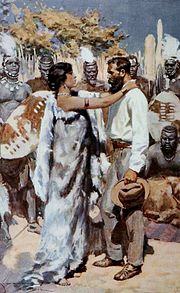 1835–1838: Marie (1912)
-
1842–1843: "Allan's Wife", title story in the collection Allan's Wife (1887)
- 1854–1856: Child of Storm (1913)
- 1858: "A Tale of Three Lions", included in the collection Allan's Wife (1887)
- 1859: Maiwa's Revenge: or, The War of the Little Hand (1888)
- 1868: "Hunter Quatermain's Story", included in the collection Allan's Wife (1887)
-
 1869: "Long Odds", included in the collection Allan's Wife (1887)
- 1870: Allan and the Holy Flower (1915)
- 1871: Heu-heu: or, The Monster (1924)
-
1872: She and Allan (1920)
- 1873: The Treasure of the Lake (1926)
- 1874: The Ivory Child (1916)
- 1879: Finished (1917)
- 1879: "Magepa the Buck", included in the collection Smith and the Pharaohs (1920)
-
 1880: King Solomon's Mines (1885)
- 1882: The Ancient Allan (1920)
- 1883: Allan and the Ice-gods (1927)
-
1884–1885: Allan Quatermain (1887)
Also added some links (mostly about Retief) and some pictures.
End Update 14 June 2013.
|
|
|
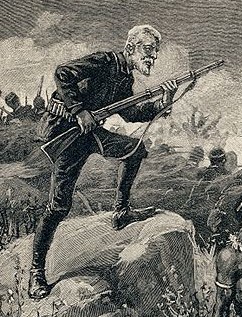 Our cousin once removed by fiction,
Allan Quatermain, first appeared in 1885 in
King Solomon's Mines,
by H. Rider Haggard.
Haggard had recently read Robert Louis Stephenson's Treasure Island,
and had been dared by a friend to do better.
So he wrote one of the great adventure novels,
and created one of the great adventurers:
Our cousin once removed by fiction,
Allan Quatermain, first appeared in 1885 in
King Solomon's Mines,
by H. Rider Haggard.
Haggard had recently read Robert Louis Stephenson's Treasure Island,
and had been dared by a friend to do better.
So he wrote one of the great adventure novels,
and created one of the great adventurers:
``...the lonely existence in wild places,
often with only the sun and the stars for companions; the continual
adventures; the strange tribes with whom I came in contact; in short,
the change, the danger, the hope always of finding something great and
new, that attracted and still attracts me, even now when I have found
the great and the new.''
—Allan Quatermain,
Child of Storm
That was Allan's own account of his motivations.
Two years later, Haggard wrote the book named after
Allan Quatermain,
in which his hero dies.
In that book Allan's friend Good writes of him:
``Tender, constant, humorous, and possessing of many of the qualities
that go to make a poet, he was yet almost unrivalled as a man of action
and a citizen of the world. ''
Chapter XXIV
I refer to Allan as our cousin in fiction, because I read
(somewhere that I have not since been able to track down)
that Haggard once said that he took the name Quatermain from some
Oxfordshire residents he knew.
Update 13 June 2013:
 Ah, here it is, in
The Days of My Life Volume I
by
Sir H. Rider Haggard, 1912, first published 1926:
Ah, here it is, in
The Days of My Life Volume I
by
Sir H. Rider Haggard, 1912, first published 1926:
I was despatched to the Rev. [H. J.] Graham, who took in two or three
small boys (at that time I must have been nine or ten years of age)
at Garsington Rectory near Oxford.
The Rectory, long ago pulled down, was a low grey house that once
had served as a place of refuge in time of plague for the Fellows of
one of the Oxford colleges. Twice, if not three times, in the course
of my after life I have revisited this spot; the last occasion being
about two years ago. Except that the Rectory has been rebuilt the
place remains just the same. There is the old seventeenth-century
dovecote and the shell of the ancient pollard elm, in the hollow
 trunk of which I used to play with a child of my own age, Mrs.
Graham's little sister Blanche, who was as fair in colouring as one
of her name should be. I believe that she has now been dead many
years.
trunk of which I used to play with a child of my own age, Mrs.
Graham's little sister Blanche, who was as fair in colouring as one
of her name should be. I believe that she has now been dead many
years.
Quite near to the Rectory and not far from the pretty church,
through the chancel door of which once I saw a donkey thrust its
head and burst into violent brays in the midst of Mr. Graham's
sermon, stood a farm-house. The farmer, a long, lank man who wore a
smart frock, was very kind to me—I found his grave in the
churchyard when last I was there. He was called [
William] Quatermain, a name
that I used in "King Solomon's Mines" and other books in after
years. After looking at this farm and the tree nearby which bore
walnuts bigger and finer than any that grow nowadays, I went to the
new Rectory and there saw working in the garden a tall, thin old
man, who reminded me strangely of one whom I remembered over thirty
years before.
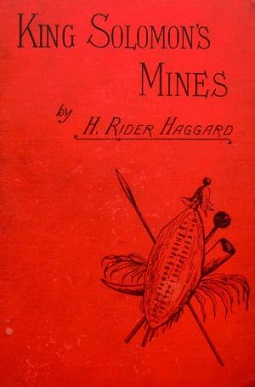 "Is your name Quatermain?" I asked.
He answered that it was. Further inquiry revealed the fact that he
was a younger brother of my old friend, whom I was able to describe
to him so accurately that he exclaimed in delight:
"That's him! Why, you /do/ bring him back from the dead, and he gone
so long no one don't think of him no more."
Also added pictures of Allan, Selous, and Connery as Allan,
plus a few links and typo fixes.
End Update of 13 June 2013.
|
And as we know, Oxfordshire
is the historical center of Quatermaines in England.
And in
America
there are French Huguenot connections
(see sidebar about Allan's first wife, Marie Marais).
I could also call Allan our cousin by diary, since an adventurer who
claimed to have discovered King Solomon's Mines is mentioned
near the historical person
Dr. William Quarterman
in the Diary of Samuel Pepys:
"Alexander St. Michel (S. Pepys father-in-law) . . . In 1667
he petitioned the king, asserting that he had discovered King Solomon's
gold and silver mines, and the Diary ... contains a curious commentary
upon these visions of wealth:--"
—
1893 introduction to the Diary of Samuel Pepys
 Both Allan and Haggard were very much creatures of their Victorian times.
Allan often didn't have much use for civlization, but he was an
unquestioning supporter of the British Empire;
Haggard and Kipling even colaborated on several books.
Allan shows a real appreciation of various cultures ranging from Boer to Zulu,
yet often he sounds racist to modern ears.
No doubt many current practices and sayings will sound barbaric a century hence.
Both Allan and Haggard were very much creatures of their Victorian times.
Allan often didn't have much use for civlization, but he was an
unquestioning supporter of the British Empire;
Haggard and Kipling even colaborated on several books.
Allan shows a real appreciation of various cultures ranging from Boer to Zulu,
yet often he sounds racist to modern ears.
No doubt many current practices and sayings will sound barbaric a century hence.
Allan was apparently modeled on assorted rugged Victorian adventurers
in Africa such as Dr. Livingstone,
Frederick Courteney Selous,
and on Haggard himself.
(I don't know if Alexander St. Michel was a model).
Allan influenced other fictional adventurers, from Strider
(Haggard was the only author Tolkien would admit had influenced him)
to Edgar Rice Borroughs' John Carter of Mars.
And Haggard's books influenced adventure
writers from Kipling to Conan Doyle
to Michael Crichton (Allan was the archetypical Great White Hunter
and Crichton's movie Congo has a character who describes himself
as a Great White Hunter who happens to be black; Haggard's books
about Allan invented the Lost Race genre, and Congo includes
a lost race; plus of course it is set in Africa.)
Yet sometimes there was more than adventure to the Quatermain stories.
 As one reviewer wrote of King Solomon's Mines,
``The story is essentially one of a hard journey that develops from a mere
treasure hunt into a voyage of the spirit.''
—
R.D. Mullen,
``The Books of H. Rider Haggard: A Chronological Survey''
There have been
several movies of Haggard's Quatermain books,
for example the ones starring Richard Chamberlain
and Sharon Stone.
Their movie of King Solomon's Mines
in 1985 was the third movie of that book,
the others having been in
1950 and 1937.
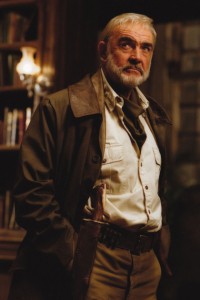 The Allan Quatermain of the 2003 movie,
League of Extraordinary Gentlemen,
based on a comic book series of the same title,
is played by Sean Connery.
The movie web pages draw a recognizable character:
The Allan Quatermain of the 2003 movie,
League of Extraordinary Gentlemen,
based on a comic book series of the same title,
is played by Sean Connery.
The movie web pages draw a recognizable character:
``His rifle aim is impeccable, his will indomitable...
and his arrogance insufferable.''
As we've seen, Allan's friends may have thought him modest,
but others may well have seen him as arrogant.
In any case, I suspect that you, if you bear the name Quarterman or Quatermaine
or any of the numerous variants, have never been able to escape it being
mistaken for that of Allan Quatermain.
So I have taken a moment to write a few words about our fictional cousin.
—jsq
Project Gutenberg Titles by
H. Rider Haggard
Marie Marais and Allan Quatermain
Child of Storm by H. R. Haggard, 3rd edition frontispiece illustration

|
![[Quarterman Family History Project]](/q/logos/qicon.gif)
![[up]](/small/arrow.up.gif)
![[prev]](/small/arrow.left.gif)
![[next]](/small/arrow.right.gif)


 Our cousin once removed by fiction,
Allan Quatermain, first appeared in 1885 in
King Solomon's Mines,
by H. Rider Haggard.
Haggard had recently read Robert Louis Stephenson's Treasure Island,
and had been dared by a friend to do better.
So he wrote one of the great adventure novels,
and created one of the great adventurers:
Our cousin once removed by fiction,
Allan Quatermain, first appeared in 1885 in
King Solomon's Mines,
by H. Rider Haggard.
Haggard had recently read Robert Louis Stephenson's Treasure Island,
and had been dared by a friend to do better.
So he wrote one of the great adventure novels,
and created one of the great adventurers:
